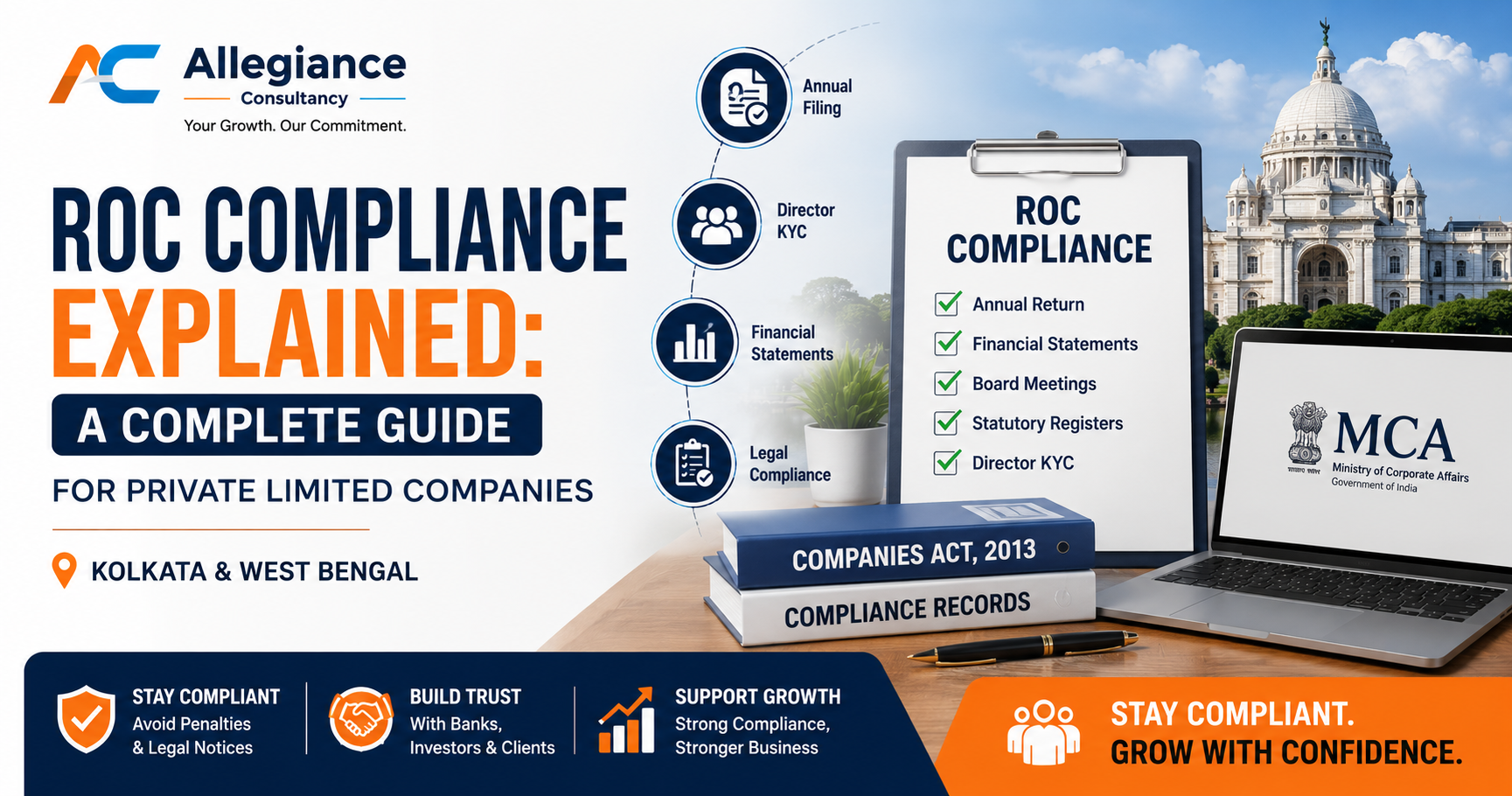
If you own a Private Limited Company, ROC compliance isn’t optional—it’s a legal responsibility.
Many business owners register their company with great excitement but later forget about the annual compliances required by the Registrar of Companies (ROC). Unfortunately, missing these compliances can result in penalties, legal notices, and unnecessary stress.
The good news? ROC compliance is not as complicated as it sounds. With proper planning and professional guidance, you can keep your company compliant without any hassle.
In this guide, we’ll explain everything in simple and easy words so you know exactly what needs to be done.
What is ROC Compliance?
ROC (Registrar of Companies) Compliance refers to the annual legal filings and company records that every Private Limited Company must maintain under the Companies Act, 2013.
These filings help the government keep updated information about your company, such as:
- Company financial details
- Directors
- Shareholders
- Registered office
- Share capital
- Business activities
👉 Think of ROC compliance like renewing important documents. Just as you renew your driving licence or insurance, your company also needs regular compliance to remain legally active.
Is ROC Compliance Mandatory?
Yes.
Whether your company is:
- Actively doing business
- Newly incorporated
- Not earning any revenue
- Temporarily inactive
You are generally required to complete the applicable annual ROC compliances.
Many business owners make the mistake of thinking:
“My company didn’t do any business this year, so I don’t need to file anything.”
That’s not correct. Even inactive companies usually have annual filing obligations.
Why is ROC Compliance Important?
Ignoring ROC compliance may not seem like a big issue today—but it can create serious problems later.
Here are some important benefits of timely ROC filing:
✅ Keeps your company legally compliant
✅ Helps avoid penalties and additional filing fees
✅ Builds trust with banks and financial institutions
✅ Improves your company’s credibility with investors
✅ Makes business loans easier
✅ Keeps directors’ records updated
✅ Reduces the chances of receiving legal notices
In simple words:
Regular compliance keeps your business safe and ready for future growth.
Key ROC Compliances Every Private Limited Company Should Know
1. Annual Financial Statements
Every financial year, your company must prepare financial statements showing how the business performed.
These usually include:
- Balance Sheet
- Profit & Loss Account
- Cash Flow Statement (where applicable)
- Notes to Accounts
These reports give a clear picture of your company’s financial health.
2. Annual Return Filing
An Annual Return contains important company information such as:
- Directors
- Shareholders
- Registered Office
- Share Capital
- Company Structure
This information needs to be updated with the ROC every year.
3. Board Meetings
Private Limited Companies are required to conduct Board Meetings as prescribed under the Companies Act.
It is also important to:
- Record meeting minutes
- Maintain proper resolutions
- Keep company records updated
4. Statutory Registers
Every company should maintain important statutory records, including:
- Register of Directors
- Register of Members (Shareholders)
- Register of Charges
- Share Transfer Records
- Other prescribed registers
Keeping these updated helps during audits and inspections.
5. Director KYC (Know Your Customer)
Eligible directors are required to complete Director KYC within the prescribed timeline.
Missing this requirement may result in the deactivation of the Director Identification Number (DIN), which can create compliance issues.
Common Mistakes Business Owners Make
Many companies receive penalties simply because of small mistakes.
Avoid these common errors:
❌ Missing filing deadlines
❌ Ignoring ROC notices
❌ Not maintaining proper books of accounts
❌ Keeping incomplete financial records
❌ Forgetting Director KYC
❌ Updating company information late
❌ Waiting until the last date to file
A little planning can save you from unnecessary stress and extra costs.
What Happens If You Don’t File ROC Returns?
Ignoring ROC compliance can become expensive over time.
Some possible consequences include:
- Additional filing fees
- Financial penalties
- ROC notices
- Director disqualification (where applicable)
- Difficulty getting business loans
- Problems attracting investors
- Challenges during company closure or ownership transfer
It’s always easier and more affordable to stay compliant than to fix compliance issues later.
Documents Commonly Required for ROC Filing
To make the filing process smooth, keep these documents ready:
✔ Certificate of Incorporation
✔ PAN of the Company
✔ Financial Statements
✔ Auditor’s Report
✔ Bank Statements
✔ Director Details
✔ Shareholding Details
✔ Registered Office Proof
✔ Previous ROC filing records (if applicable)
Having these documents organised can save time during annual filing.
Simple Tips to Stay ROC Compliant
Following a few good habits can make compliance much easier.
✔ Maintain proper accounting records throughout the year
✔ Keep company documents organised
✔ Don’t wait until the last week before filing
✔ Track important compliance dates
✔ Consult a professional whenever you’re unsure
✔ Review your company records regularly
Talk to Allegiance Consultancy
Whether you need a Cash Credit (CC), Overdraft (OD), Business Loan, HBL Loan or Loan Against Property (LAP), our experts help businesses across Kolkata and West Bengal secure the right funding with proper guidance and documentation.
📍 Visit Our Office
East India House, 5th Floor20B, Abdul Hamid Street
Behind Lalit Great Eastern Hotel
Kolkata – 700069
West Bengal, India